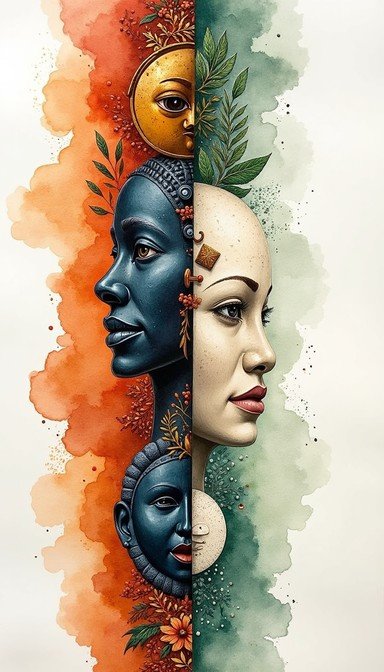
It’s a familiar feeling: stepping out of a high-stakes meeting, you’re the picture of corporate composure, only to shed that persona moments later, morphing into the playful, slightly chaotic parent tackling bath time. Or perhaps you’re the quiet artist by night, known for introspective work, but a charismatic leader in your community by day. This dynamic interplay isn't a sign of inauthenticity; it’s at the heart of The Dual Identity & Character Evolution, a concept reshaping how we understand ourselves and our place in the world.
We all wear different hats, adapting our behavior and even our internal landscape to suit various contexts. But what happens when these "hats" feel like entirely different people? When does adaptation become fragmentation, and how can we leverage these multiple facets of self for growth instead of internal conflict? This article dives deep into these questions, offering a journalist's perspective on a profound psychological and philosophical journey.
At a Glance: Navigating Your Multiple Selves
- Understanding the Core: Dual identity isn't just "role-playing"; it's a deeper, often unconscious, manifestation of distinct character facets that emerge in different contexts.
- Why It Happens: We evolve dual identities for adaptation, protection, social navigation, and personal growth, reflecting a fundamental human capacity for complexity.
- The Pitfalls: Unmanaged dual identities can lead to internal conflict, imposter syndrome, burnout, and a sense of inauthenticity.
- Embracing Nuance: Academic research (Dranseika, Knobe) suggests that holding contradictory intuitions about identity can be valid, with different "selves" being "right in a certain sense."
- Path to Integration: Strategies like self-awareness, defining core values, setting boundaries, and leveraging each identity's strengths can lead to a more harmonious, authentic self.
- It's an Evolution: Your character isn't static. Dual identities are part of an ongoing process of growth, adaptation, and self-discovery throughout life.
What Exactly is "Dual Identity" Beyond a Simple Role?
At its simplest, a dual identity refers to having two distinct modes of being or expressions of self, often characterized by different behaviors, values, motivations, and even emotional responses, depending on the context. It’s more profound than merely playing a role; it often involves a genuine shift in one's sense of self.
Think about the famous philosophical puzzle, the Ship of Theseus. If you replace every plank of an old ship, is it still the same ship? Now, apply that to a person. Are you the same person you were five years ago, after significant life changes, new relationships, and career shifts? Researchers exploring "personal identity and dual character concepts" have found that people can hold fascinating, seemingly contradictory views on such questions. For instance, some believe both "yes" and "no" answers to the Ship of Theseus puzzle are correct, perhaps "one in a certain sense while the other is right in a deeper sense," as noted by Knobe (2022). This isn't confusion; it's a reflection of our innate capacity for nuanced self-perception.
A dual identity, therefore, isn't necessarily about deception. Instead, it speaks to the multifaceted nature of human psychology, where various facets of our character — our “self” — emerge as necessary or appropriate. It’s about the dynamic interplay of these facets and how they evolve over time.
The Many Faces of Our Dual Selves: More Common Than You Think
You might imagine a secret agent living a double life, but the reality of dual identity is far more pervasive and mundane. We experience it in various forms every single day.
The Public Persona vs. The Private Self
This is perhaps the most universal dual identity. The curated image you present on social media or at work, brimming with confidence and competence, often differs markedly from the person who unwinds at home, perhaps prone to anxiety or quirky habits. The public self is often a shield, a performance, or an aspiration, while the private self is where vulnerability and raw authenticity reside.
The Professional vs. The Personal
Consider the stern, decisive CEO who, outside the boardroom, is a gentle, doting parent. These aren't just different roles; they often activate different skill sets, emotional regulations, and priorities. The character traits valued in one sphere (e.g., ruthless efficiency) might be detrimental in another (e.g., family life).
The Past Self vs. The Present Self
This dual identity emerges over time. The carefree college student, perhaps prone to impulsive decisions, often stands in stark contrast to the mature adult burdened with responsibilities. While you carry remnants of your past, your present self has adapted, learned, and potentially shed old habits and beliefs. Confronting this past self can be a powerful journey of reflection.
The Aspirational Self vs. The Actual Self
We often hold an image of who we want to be: healthier, more disciplined, more creative. This aspirational self is a driving force, but it can also be a source of internal tension when it clashes with our actual, imperfect self. The dual identity here is between the ideal and the reality, and the constant striving to bridge that gap.
The "Hidden" or Subconscious Self
Sometimes, a dual identity isn't consciously chosen but emerges from deeper psychological currents. These might be aspects of our character that we've suppressed or are unaware of – our shadow self, our unfulfilled desires, or even latent talents. These "hidden" identities can emerge unexpectedly, sometimes through art, dreams, or intense emotional experiences.
A prime example of navigating distinct, yet intertwined, identities in the public eye is The Miley Cyrus Hannah Montana story. For years, Miley Cyrus perfectly embodied the bubbly, innocent pop star Hannah Montana, a persona crafted for a younger audience. Behind the scenes, and eventually in her adult career, Miley evolved into a provocative, boundary-pushing artist distinct from her Disney Channel alter ego. This wasn't merely acting; it represented a deep engagement with two different identities, each serving a unique purpose and audience, and the eventual challenge of integrating or distinguishing them.
Why Do We Develop Dual Identities? The Evolutionary Advantage
Dual identities aren't simply a modern phenomenon; they're deeply rooted in human psychology and have served crucial functions throughout our evolution.
- Adaptation and Survival: In a complex social world, the ability to adapt your persona to different groups or situations can be a matter of social survival, allowing you to fit in, gain acceptance, or avoid conflict. Early humans might have needed to be ruthless hunters in one context and nurturing community members in another.
- Coping Mechanisms: Dual identities can serve as a protective shield. If one aspect of your life is highly stressful or emotionally taxing, compartmentalizing that experience into a "work self" or "public self" can help your "private self" maintain a sense of peace or normalcy.
- Social Navigation: We intuitively understand that different social settings require different behaviors. Being boisterous at a party is fine, but not in a quiet library. Developing distinct social identities allows us to navigate these unwritten rules smoothly.
- Personal Growth and Exploration: Trying on different identities, experimenting with new behaviors, or exploring different aspects of your character is a fundamental part of growth. Adolescence, for example, is a period of intense identity exploration, often involving trying on many "selves" before settling into a more integrated identity.
- Protecting Vulnerability: Presenting a confident, impenetrable front can protect your inner, more vulnerable self from judgment, criticism, or harm. This protective layer is a natural human defense mechanism.
The Pitfalls: When Dual Identities Create Internal Conflict
While beneficial, the existence of multiple identities isn't always harmonious. When these facets aren't well-integrated, they can lead to significant psychological distress.
- Identity Crisis and Fragmentation: Feeling like you don't know who "the real you" is, or that you're constantly "performing," can lead to a profound sense of fragmentation. This can manifest as anxiety, confusion, or a feeling of being unmoored.
- Imposter Syndrome: This common experience often stems from a dual identity conflict. You might feel like your "professional self" is a fraud, while your "private self" doubts your capabilities. The fear is that your "true" (often perceived as less capable) self will be exposed.
- Burnout: Constantly maintaining a demanding persona can be exhausting. The energy required to suppress one identity while upholding another can lead to emotional and physical depletion.
- Authenticity Struggles: The desire to be "authentic" is strong, but when you feel you have to hide parts of yourself or maintain multiple contradictory personas, it can feel like you're living a lie, leading to guilt or shame.
- Internal Dissonance: As research by Deery et al. (2015) suggests, individuals can hold "contradictory statements" or intuitions without noticing the conflict. This internal dissonance, when it comes to self-perception, can create a nagging unease or a subtle sense of being at odds with yourself. It's the friction between what one identity believes and what another experiences.
Embracing the Nuance: Beyond "Fake" or "True"
It's tempting to categorize our dual identities as "fake" or "true," but this binary thinking often misses the point. The reality is far more nuanced. As Knobe (2022) implied, one aspect of your character might be "right in a certain sense" (e.g., your effective professional self) while another is "right in a deeper sense" (e.g., your core, vulnerable self). Both can be valid, authentic expressions of you within their respective contexts.
Think of it like this: your smartphone has many apps – a navigation app, a camera app, a messaging app. Each serves a distinct function, operates differently, and reveals a different capability of the phone. Yet, they all run on the same device. Similarly, your dual identities are like different "apps" or "modes" of your core self. They are all expressions of you, tailored for specific situations. The goal isn't to delete apps but to learn to switch between them effectively and understand how they contribute to the overall functionality of the "device."
The journey is not about eliminating your dual identities but about integrating them. It’s about understanding that your strength lies not in being one singular, unchanging entity, but in your capacity to adapt, learn, and express different facets of your rich inner world coherently.
Strategies for Harmonizing Your Dual Identities
The path to integrating your dual identities isn't about choosing one over the other, but about creating a coherent narrative that acknowledges and values each part. Here’s how to start:
1. Self-Awareness as Your Compass
This is the foundational step. You can't harmonize what you don't understand.
- Journaling: Regularly writing about your experiences, thoughts, and feelings in different contexts can reveal patterns. Notice when different facets of your personality emerge, what triggers them, and how they feel.
- Mindfulness and Reflection: Pay attention to your internal state throughout the day. When you switch roles (e.g., leaving work for home), observe the mental and emotional shift. What changes? What stays the same?
- Identify Triggers: What situations, people, or environments tend to bring out certain identities? Understanding these triggers gives you agency.
2. Defining Your Core Values: The Bedrock Beneath All Identities
Beneath all the roles and personas lies a set of fundamental principles that guide you. These are your core values.
- List Your Top 3-5 Values: Are they integrity, creativity, family, contribution, freedom, security? Write them down.
- Test Your Identities Against Them: Do your "professional self" and your "personal self" align with these core values? If one identity consistently clashes with a core value, it's a signal for re-evaluation. For example, if "integrity" is a core value, but your professional self often compromises it, that's an area for integration work.
- Live from Your Core: Make conscious decisions to act in alignment with your core values, regardless of the identity you're currently inhabiting. This creates a powerful sense of consistency and authenticity.
3. Strategic Boundary Setting: Giving Each Self Space
Clear boundaries are crucial for preventing identity bleed-over and burnout.
- Physical Boundaries: Create distinct spaces for different identities (e.g., a home office, a meditation corner).
- Temporal Boundaries: Schedule specific times for different activities, and try to stick to them. Don't check work emails after 7 PM if your "family self" needs dedicated time.
- Emotional Boundaries: Learn to "leave" certain emotional states in one context. For instance, deliberately shed the stress of work before entering your home life. A simple ritual, like changing clothes or listening to a specific song, can help signal this transition.
4. Intentional Context Switching: Mastering the Transition
Moving between identities doesn't have to be jarring. It can be a conscious, graceful act.
- Rituals: Develop small rituals to help you switch. This could be a specific playlist for your commute to shift from personal to professional mode, a change of shoes, or a five-minute mindfulness exercise.
- Pre-Paring: Before entering a new context, mentally prepare for the identity you need to embody. Visualize yourself in that role, activate the relevant traits, and set your intentions.
5. Seeking Feedback from Trusted Others: External Perspective
Sometimes, we're blind to how our different identities are perceived.
- Ask for Honest Input: Approach close friends, family, or mentors and ask them, "How do you see me in different situations?" "Do you notice differences in how I behave at work versus at home?"
- Observe Reactions: Pay attention to how people respond to different versions of you. This can offer valuable clues about the impact of your various identities.
6. Accepting Imperfection and Contradiction: It's Human
Trying to be perfectly consistent across all identities is an impossible and unhealthy goal. Humanity is complex.
- Embrace Paradox: It's okay to be both strong and vulnerable, introverted and extroverted, logical and emotional. These aren't contradictions to be resolved but facets to be appreciated.
- Self-Compassion: Be kind to yourself when you notice internal conflicts or when one identity feels "messy." Growth is a process, not a destination.
7. Leveraging Each Identity's Strengths: Mutual Enrichment
Instead of viewing your dual identities as separate entities, consider how they can cross-pollinate and strengthen each other.
- What does your "professional self" teach your "personal self"? Perhaps it's organizational skills, confidence, or strategic thinking.
- What strengths does your "personal self" bring to your "professional self"? Empathy, creativity, resilience, or a sense of humor.
- Find Synergy: Look for opportunities where traits from one identity can enhance another. A leader who is also a parent might bring unique empathy to their team; an artist might bring creative problem-solving to their corporate role.
Micro-Examples in Action:
- The Quiet Artist, Loud Manager: Sarah is a successful product manager, known for her assertive decision-making and clear communication. Yet, in her personal life, she's a soft-spoken painter who spends hours in quiet contemplation. She integrates these by using her manager's organizational skills to structure her art projects and her artist's creativity to find innovative solutions in her job. She maintains boundaries by having strict "no work talk" rules in her art studio.
- The Parent-Activist: Mark is a dedicated father, always patient and nurturing with his children. But he's also a passionate environmental activist, capable of fiery speeches and organized protests. He aligns these by showing his children the importance of standing up for beliefs (core value: justice) and uses his parental empathy to connect with diverse groups during his activism. He leverages his "activist self" to teach his kids about social responsibility, ensuring both identities reinforce his core values.
Common Questions & Misconceptions About Dual Identity
Let's clear up some common misunderstandings.
"Is it manipulative to have a dual identity?"
Not inherently. Manipulation involves deceit and exploitation for personal gain, often at another's expense. Adapting your behavior or expressing different facets of your character based on context is a social skill and a sign of flexibility. It becomes manipulative only if you are intentionally misleading others about your core intentions or values, or using a persona to exploit trust. True dual identity is about authenticity in different contexts, not about faking sincerity.
"Does having a dual identity mean I'm not authentic?"
This is a profound misconception. Authenticity isn't about being a static, singular self at all times. It's about being true to yourself in the moment and aligning your actions with your core values. Your authentic self is vast enough to contain multiple facets. The key is that these facets feel congruent with your deeper self, even if they look different on the surface. When you consciously suppress a part of yourself that genuinely wants to express itself, that's when you might feel inauthentic.
"How is this different from Multiple Personality Disorder (Dissociative Identity Disorder)?"
This is a critical distinction. Dissociative Identity Disorder (DID) is a severe mental health condition characterized by the presence of two or more distinct personality states (or "alters") that recurrently take control of the individual's behavior, accompanied by memory gaps. It is usually caused by severe, prolonged trauma in childhood and involves a profound fragmentation of identity.
Dual identity, as discussed here, is a normal, healthy, and adaptive psychological phenomenon. You remain aware that you are one person expressing different facets of your character, and you generally retain memory and control across these "identities." You are the orchestrator of your various selves; in DID, the "alters" often operate autonomously.
The Evolutionary Journey: Character Development Over Time
Your character isn't a fixed sculpture; it's a living, breathing entity, constantly shaped by experience and choice. The concept of "The Dual Identity & Character Evolution" highlights that these facets of self are not static.
- Life Events as Catalysts: Major life changes—parenthood, career shifts, loss, trauma, relocation—often act as powerful catalysts, forcing the emergence of new identities or the re-evaluation of existing ones. A crisis can strip away old personas, revealing core strengths or vulnerabilities that become new facets of self.
- Continuous Integration: The process of harmonizing dual identities is not a one-time fix but an ongoing journey. As you grow, learn, and experience new things, your identities will continue to evolve. What felt integrated at 25 might need re-evaluation at 40.
- The Power of Narrative: You have the power to create a coherent narrative that connects all your identities. By understanding the purpose each identity serves and how they contribute to your overall being, you can weave a rich tapestry of selfhood.
Your Integrated Self: A Path Forward
Embracing your dual identity is not about choosing which "you" is real, but about understanding that all your selves contribute to the vibrant, complex, and evolving person you are. It's an acknowledgment of human adaptability, resilience, and the capacity for growth.
Start by observing, then understanding, and finally, integrating. Recognize the strengths each identity brings to your life. Challenge the notion that you must always be one thing. Instead, cultivate self-awareness, define your unchanging core values, and build strategic bridges between your various facets. The goal isn't perfect consistency, but rather a profound internal coherence where all parts of you feel recognized, valued, and aligned with your truest self. This ongoing journey allows you to not just cope with your multiple selves, but to truly thrive in their complexity.